That familiar tension in your shoulders after a surprise email. The racing thoughts before a big presentation. The tight jaw you only notice once the day has already gone sideways. Stress often hits fast, but relief doesn’t have to mean clearing your calendar or booking a weekend away.
What helps most in real life is having a small set of quick stress relief techniques you can reach for right where you are. At your desk. In the car before school pickup. In the bathroom between meetings. On the couch when your brain won’t stop replaying the day.
This guide is built like a stress toolkit, not a vague wellness wish list. Each technique gives you a rough time-to-relief, the setting where it works best, and a follow-up idea so the calm lasts longer than a minute. Some of these are physical. Some are sensory. Some work better when you’re mentally overloaded, while others help more when your body feels revved up.
If you’ve ever tried “just meditate” and felt even more annoyed, you’re not doing it wrong. The trick is matching the tool to the moment.
1. Mindful Coloring and Art Therapy
Time to relief: 5 to 10 minutes
Best for: At your desk, after work, waiting rooms, evening wind-down
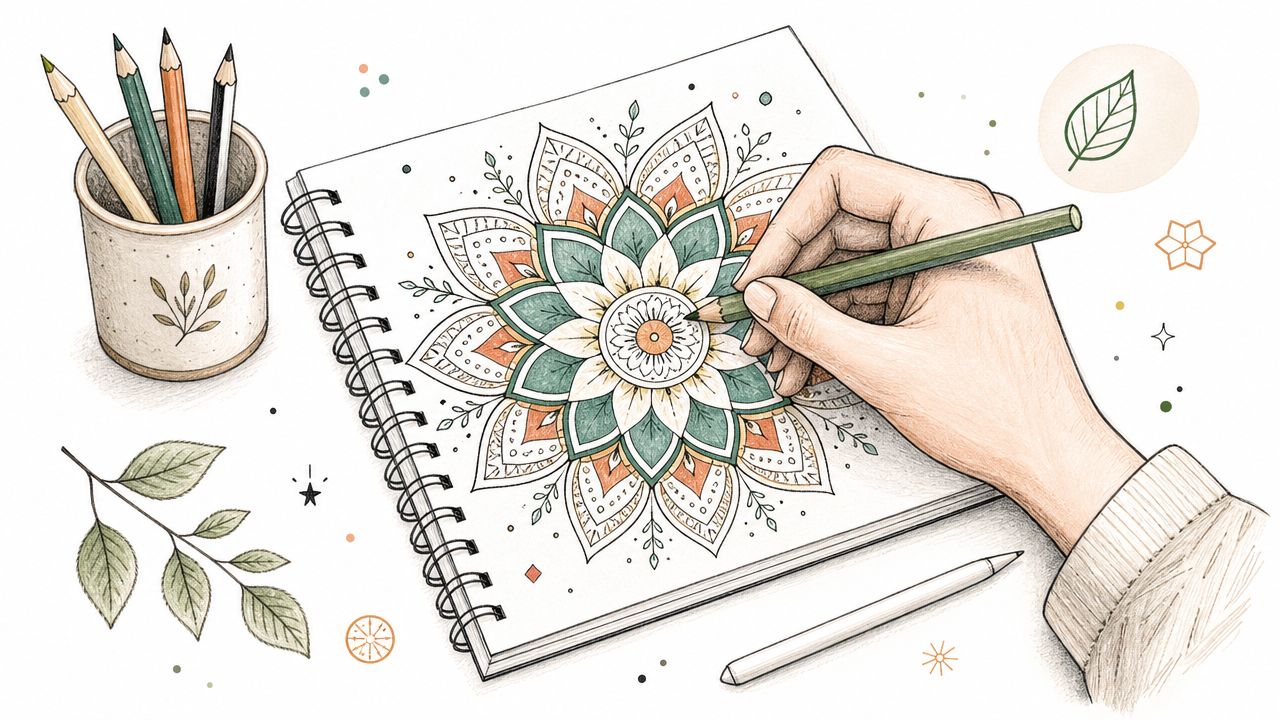
Coloring works well when your mind feels scattered but sitting in silence sounds impossible. Your hands have something concrete to do, your eyes get a single point of focus, and your attention narrows without demanding a lot from you. That’s a big reason it feels easier than “relaxing on command.”
I like this one for stress that feels buzzy rather than heavy. If your thoughts are hopping from one unfinished task to another, a page with repeating shapes or simple patterns can act like a visual exhale.
Why coloring works when your brain feels noisy
The best approach is to make it friction-free. Pick a page, choose a small color palette, and fill one section at a time. You don’t need to finish anything. A half-colored page can still do its job.
If paper helps you disconnect, use a sketchbook or adult coloring book. If convenience matters more, digital coloring can be great too, especially if it keeps distractions lower than your usual apps. You can browse free coloring pages for quiet breaks if you want something easy to start with.
- Use simple designs first: Dense, intricate pages can feel soothing for some people and irritating for others. Start with bold shapes or nature pages if you’re already tense.
- Keep the session small: Five minutes is enough to break the stress spiral. You can always keep going if it feels good.
- Choose colors by mood, not rules: If soft greens calm you, use them. If bright orange helps you feel more awake and less shut down, that counts too.
Coloring isn’t about making art. It’s about giving stress less room to run.
A creative follow-up that works surprisingly well is pairing coloring with one slow exhale per stroke or per section. That turns it into a quiet rhythm instead of just another thing to complete.
2. Deep Breathing and Box Breathing Techniques
Time to relief: 1 to 5 minutes
Best for: Before meetings, in traffic, between tasks, right after a stressful message
Your chest tightens after reading an email that changes your whole mood. That is a good moment to use breathwork because it gives your body a job to do right away.
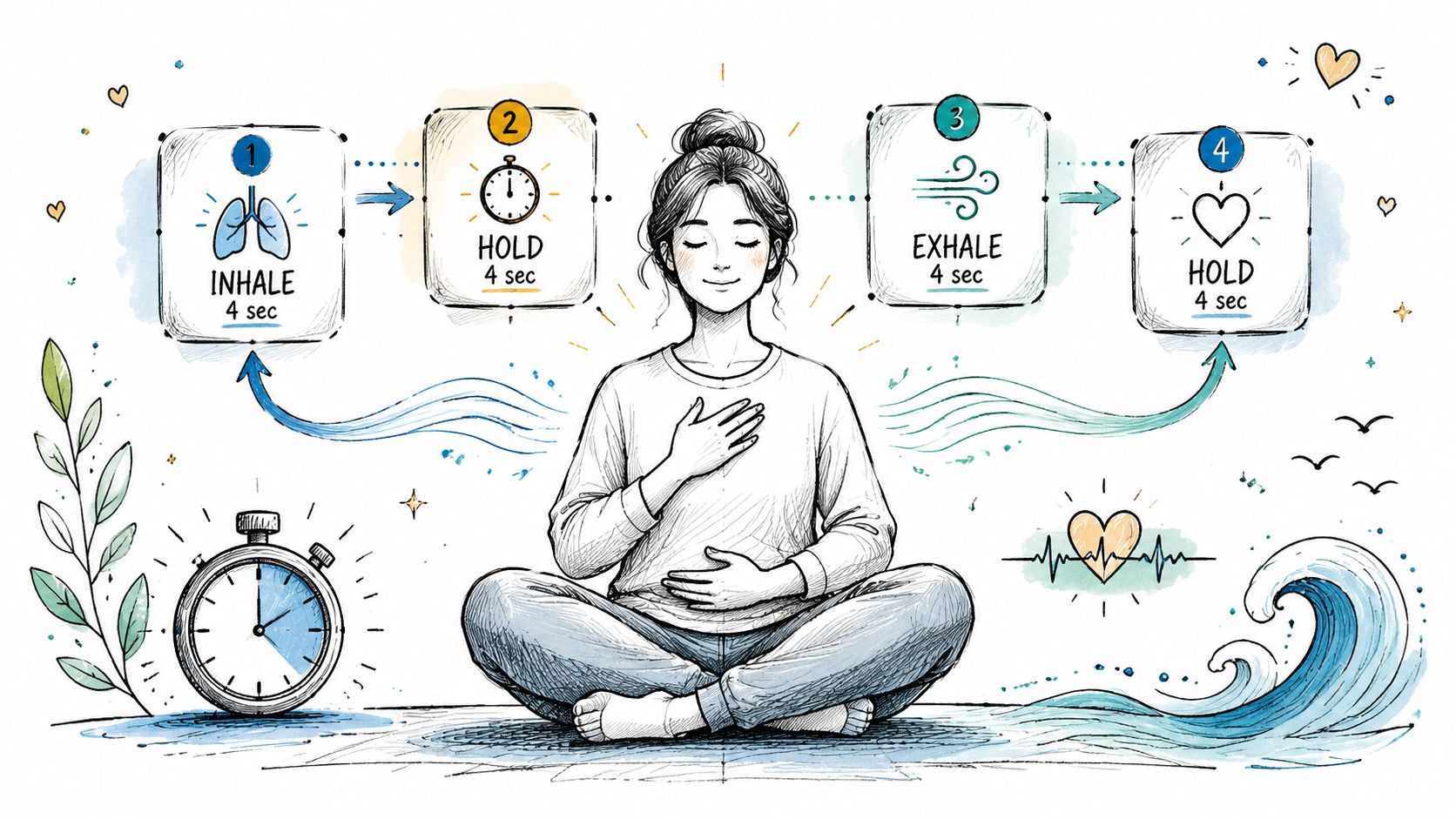
Box breathing is one of the easiest tools to remember under pressure. You inhale for 4, hold for 4, exhale for 4, then hold for 4 again. The pattern is simple enough to recall when your mind is scattered, and structured enough to interrupt the stress loop.
If that count feels stiff, use a softer option. Healthdirect describes slow breathing as inhaling to a count of 3 and exhaling to a count of 6. That longer exhale often feels better for people who get more tense when they have to hold their breath.
How to do it without making yourself more tense
Start by relaxing the parts of the body that often stay braced.
- Box breathing: Inhale for 4, hold for 4, exhale for 4, hold for 4.
- Slow breathing: Inhale for 3, exhale for 6.
- Low-key desk version: Unclench your jaw, drop your shoulders, rest your tongue, then begin.
Keep the breath quiet. Keep it smaller than you think.
That trade-off matters. Bigger breaths are not always better. If you are already anxious, forcing a deep inhale can make you feel air hungry or overly focused on your heartbeat. In practice, a light, steady breath usually works faster than trying to breathe perfectly.
The CDC includes deep breathing, stretching, and meditation among everyday coping tools in public-health guidance. That matters because it puts breathing in the category of practical daily support, not something you only do in ideal conditions.
Practical rule: If counting increases stress, stop counting. Slow the exhale and let the rhythm be loose.
For a toolkit approach, set a tiny target. Do four rounds before a meeting. Do one minute after a hard conversation. Then follow it with a short pau. coloring break and match one color fill to one exhale. That pairing works well when you need help staying calm for a few minutes longer, not just for the first minute.
3. Progressive Muscle Relaxation (PMR)
Time to relief: 2 to 5 minutes for a quick round
Best for: At your desk, before sleep, after conflict, when stress feels physical
You close the laptop after a tense message, and your body is still in the argument. Your jaw is tight. Your shoulders are halfway to your ears. Your hands want to keep gripping. That is a good moment for progressive muscle relaxation, or PMR.
PMR helps when stress shows up as bracing, clenching, or restlessness. Instead of trying to reason your way out of tension, you create a clear physical contrast. Tighten a muscle group on purpose, then release it fully. That release is the point. It teaches your body what “off” feels like.
A quick PMR round you can do almost anywhere
Start with the areas that tend to hold the most tension. Keep the effort firm but not painful.
- Hands: Make fists. Hold briefly. Release and let the fingers spread.
- Shoulders: Shrug up. Hold briefly. Drop them completely.
- Face: Squeeze the eyes and jaw gently. Release, then let the tongue rest.
- Legs or feet: Press your feet into the floor or tighten your thighs. Release.
If you are at work, go smaller. Press your toes into your shoes. Tighten your thighs under the table. Soften your forehead and unclench your jaw between sentences. Small versions still work because PMR is about noticing contrast, not performing a big routine.
A guided video can help if you want to learn the flow before doing it on your own:
One trade-off matters here. If you rush through every body part, PMR turns into another task to complete. If you tense too hard, you can leave yourself feeling more wound up. A lighter squeeze and a slower release usually works better, especially if you are already overstimulated.
Practical rule: Spend more attention on the release than the squeeze.
For your stress toolkit, use PMR as a reset after a hard conversation or before sleep, when your body feels stuck in “go” mode. Then add a creative follow-up. Open pau. and do a short coloring session right after. The muscle release makes your grip looser and your breathing steadier, which helps the calm last longer than one minute.
4. Guided Visualization and Mindfulness Meditation
Time to relief: 3 to 10 minutes
Best for: Before bed, after overstimulation, during a quiet break, on headphones during a commute
When people say meditation doesn’t work for them, they usually mean one of two things. Either they tried to “empty their mind” and got frustrated, or they were too activated for stillness to feel safe or useful. That’s why I treat visualization and mindfulness as separate tools, even though they overlap.
Visualization gives the mind somewhere to go. Mindfulness asks it to stay where it is. One can feel easier than the other depending on the kind of stress you’re carrying.
When stillness helps and when it doesn’t
Guided imagery works best when you need a softer internal environment. Think beach, forest trail, warm room, rain on windows, or any place your body associates with less pressure. Add sensory detail. What do you hear, feel, smell, or see?
Mindfulness works better when you can tolerate noticing the present moment without immediately spiraling. That might be feeling your feet on the floor, noticing your breath, or listening to ambient sound for a minute without judging it.
If breathing exercises make you more aware of anxiety, switch tools. Use sound, touch, or visual focus instead of forcing stillness.
That matters because quick relief isn’t always the right tool for every state. Authoritative stress guidance also notes that if stress is persistent or self-care isn’t helping, therapy or counseling may be a better next step than stacking more mini-techniques. This Mayo Clinic stress-relief overview makes that distinction clearly.
A good follow-up is using pau. after a short audio meditation. The visualization settles the mind, then coloring keeps you from bouncing right back into notifications and mental clutter.
5. The 5-4-3-2-1 Grounding Technique (Sensory Awareness)
Time to relief: 1 to 3 minutes
Best for: Crowded places, panic-y moments, pre-presentation nerves, overstimulating workdays
Your mind is already three steps ahead. Your shoulders are up, your jaw is tight, and you need something you can do without closing your eyes or leaving the room. This is the grounding tool I reach for in that kind of moment because it gives the brain a simple job.
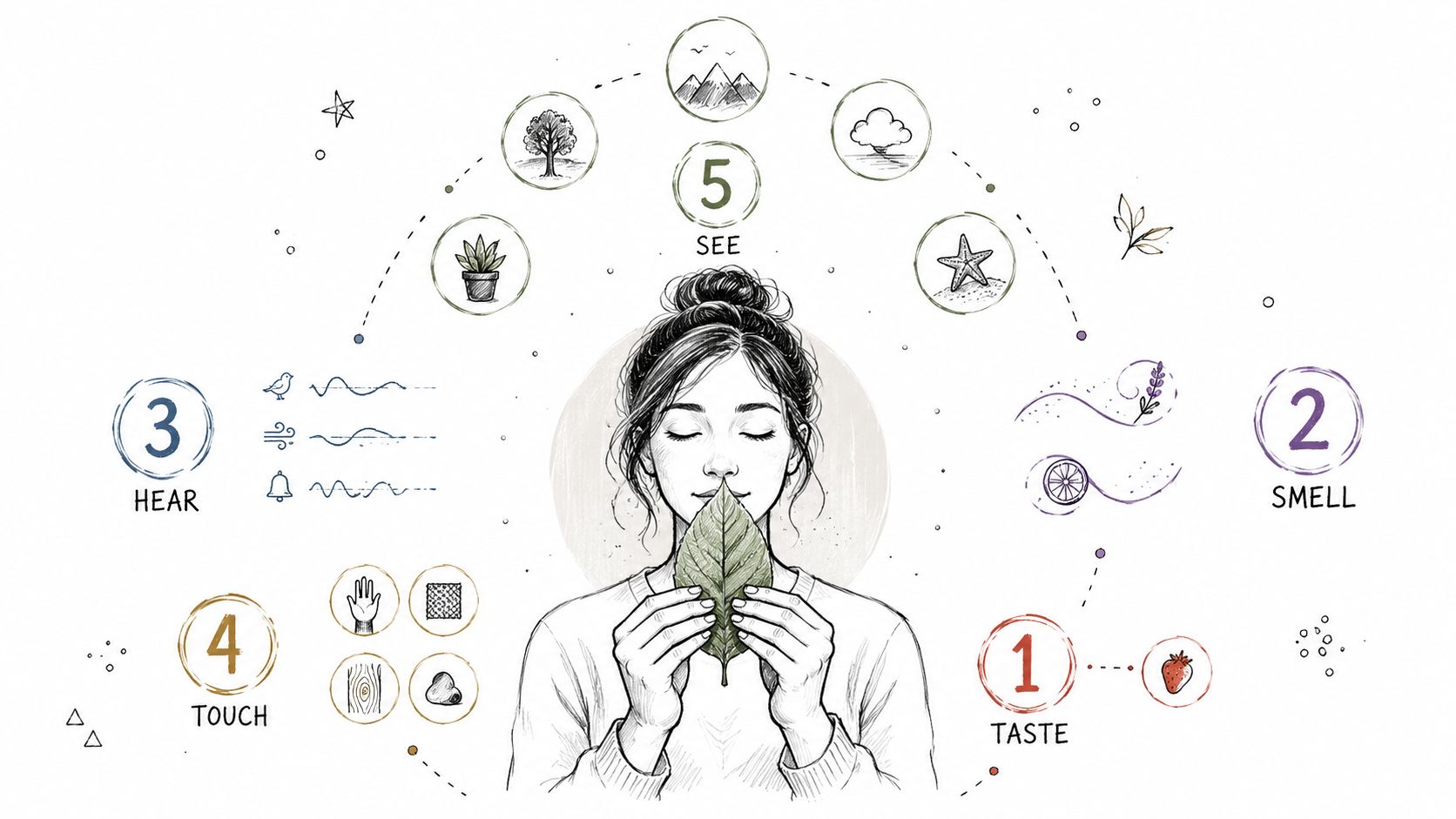
Use the sequence in order. Name 5 things you can see, 4 you can feel, 3 you can hear, 2 you can smell, and 1 you can taste. You do not need perfect answers. You need specific ones. “Blue pen,” “cool desk edge,” “air vent,” and “mint gum” work better than vague labels because detail helps pull attention out of the stress spiral and back into the present.
How to use it in real life
This technique works well in places where other stress tools feel awkward or too inward.
- At your desk: Spot five visible objects, press your feet into the floor, notice office sounds, catch the scent of coffee or hand soap, then take a sip of water.
- On a commute: Use the seat under your legs, the temperature of the air, the rhythm of the train or bus, a jacket zipper in your hand, and the taste of gum or tea.
- Before a hard conversation: Do the short version. Pick one thing to see, one to touch, and one to hear. Even that can slow the rush.
There is a trade-off. If noise, bright light, or touch already feel like too much, running through all five senses can add friction instead of relief. Scale it down. Stay with one sense only. Look at a single object, hold something cool, or listen for one steady sound until your body settles.
For a follow-up, keep the sensory focus going with a coloring page in pau. Name what you notice while you color: rough paper, dark green, soft pressure, warm hands, quiet corner. That turns this from a fast reset into a small stress toolkit you can use for a few minutes longer.
6. The Pomodoro Technique with Microbreaks
Time to relief: 5 minutes during breaks, with stress prevention built in
Best for: Workdays, studying, caregiving admin, long computer sessions
Some of the best stress relief happens before you’re fully stressed. That’s why I like Pomodoro for people who keep pushing until they crash. It creates an actual container for effort and a built-in cue to stop bracing.
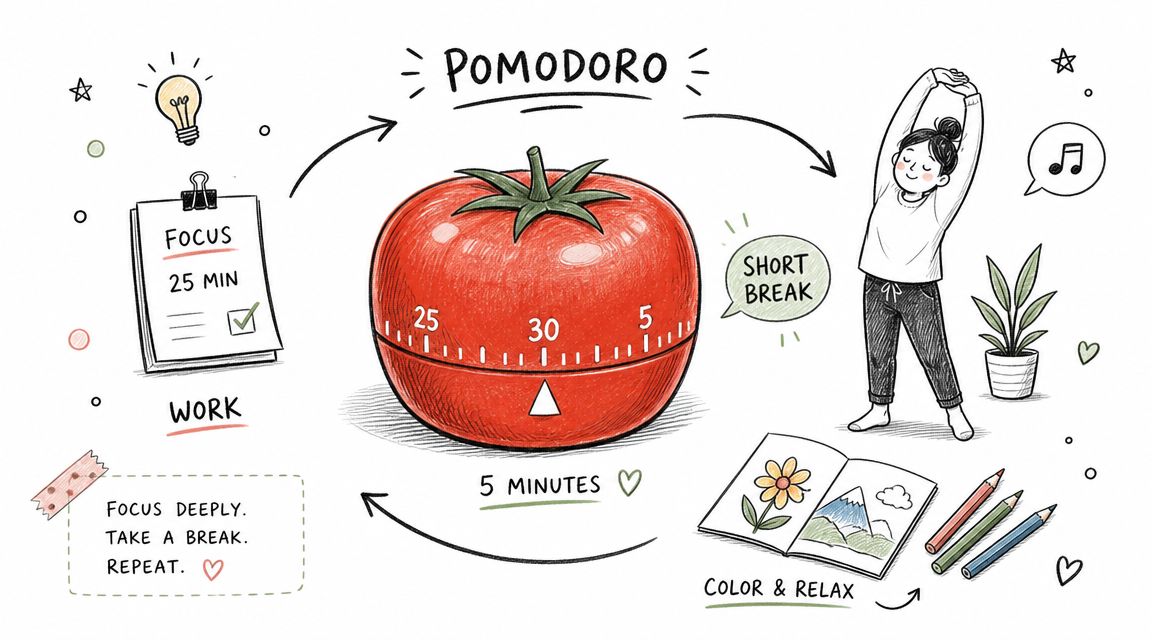
The classic flow is a work interval followed by a short break. What matters most isn’t strict productivity purity. It’s that you step away before your body hardens into all-day tension.
Use breaks before stress piles up
Movement-based micro-breaks are strongly supported in everyday guidance. Short walks, stretching, yoga, and low-impact exercise are commonly suggested in the range of 15 to 30 minutes a day, with the CDC recommending building activity gradually to about 2.5 hours per week in smaller blocks such as 20 to 30 minutes per day. That supports the basic idea behind microbreaks: shorter bouts still count.
During your break, don’t default to doom-scrolling. Pick a reset with a clear end point.
- Move: Walk the hall, stretch your chest, roll your neck, stand in sunlight.
- Downshift: Do a minute of breathing or a short sensory grounding round.
- Create: Use pau. for a five-minute coloring break that feels restorative instead of stimulating.
Five minutes of actual recovery beats five minutes of frantic scrolling.
What doesn’t work is treating breaks like task-switching. If your “break” becomes checking messages, paying bills, and replying to one more email, your nervous system never gets the cue that the threat has passed.
7. Journaling and Expressive Writing
Time to relief: 5 to 15 minutes
Best for: End of day, after conflict, when you can’t stop replaying a situation
Journaling helps when stress is sticky. Not always loud, not always urgent, just circling. If your mind keeps rehearsing the same argument, worry, or unfinished decision, writing gives those thoughts somewhere to go besides another lap in your head.
The trick is to lower the bar. This isn’t about insight on demand. It’s about unloading pressure.
Write to unload, not to perform
Start with one honest sentence. “I’m angry because…” or “What I’m worried about is…” usually gets you further than trying to summarize your whole day. Keep the pen moving, or type without editing.
A few useful prompts:
- Name the pressure: What feels unfinished, unfair, uncertain, or out of control?
- Separate fact from fear: What happened, and what are you predicting?
- Close the loop: What’s one next step, or what can wait until tomorrow?
This is also a good option when breathing makes you more agitated. Some people calm down by moving air. Others calm down by moving thoughts out of their head and onto a page. Neither approach is more “correct.”
One of my favorite pairings is writing first, then coloring after. Writing clears the noise. Coloring softens the edges. If your brain tends to rev up at night, that sequence often feels easier than trying to fall asleep straight from a stress spiral.
7 Quick Stress-Relief Techniques Compared
| Technique | Implementation complexity | Resource requirements | Expected outcomes | Ideal use cases | Key advantages |
|---|---|---|---|---|---|
| Mindful Coloring and Art Therapy | Low, minimal skill, easy setup | Low, paper/pencils or tablet app | Reduced anxiety, improved focus, relaxation | Short breaks, workplace wellness, creative downtime | Accessible, tactile, produces tangible creative output |
| Deep Breathing and Box Breathing | Very low, quick to learn, needs practice | None, body-based, optional guided app | Immediate drop in heart rate and anxiety | Acute stress, meetings, on-the-go moments | Fast, evidence-based, highly portable |
| Progressive Muscle Relaxation (PMR) | Moderate, guided sequence, 10–20 min | None, quiet space, optional audio guide | Reduced muscle tension, better sleep, bodily awareness | Pre-sleep routines, chronic tension, therapy sessions | Systematic full-body relaxation, measurable effects |
| Guided Visualization & Mindfulness Meditation | Low–Moderate, guided aids help adherence | Low, quiet space, audio/app recommended | Reduced anxiety long-term, improved clarity and focus | Commutes, breaks, sleep prep, focused sessions | Multi-sensory, scalable, widely available via apps |
| 5-4-3-2-1 Grounding Technique (Sensory Awareness) | Very low, simple sequential steps | None, uses immediate environment | Rapid grounding, interrupts panic and racing thoughts | Panic attacks, acute anxiety, situations of dissociation | Immediate, portable, easy to teach to others |
| Pomodoro Technique with Microbreaks | Low–Moderate, requires scheduling discipline | Low, timer or app, brief break activities | Increased productivity, reduced burnout over time | Focused work/study blocks, remote work, time management | Integrates work-rest balance, enforces regular recovery |
| Journaling and Expressive Writing | Low–Moderate, needs uninterrupted time | Low, pen/paper or digital journal | Long-term stress reduction, clearer emotional processing | Reflection, therapy, processing difficult emotions | Promotes insight, documents progress, clinically validated |
Build Your Personal Stress Relief Toolkit
Stress is part of life, but it doesn’t need to run the whole day. What helps most is having a few quick stress relief techniques that match different kinds of stress, not relying on one perfect method for every moment.
If your body feels tight and restless, start with muscle relaxation or a short movement break. If your mind is racing, try box breathing or 5-4-3-2-1 grounding. If you feel emotionally full and mentally noisy, journaling or coloring may work better than meditation. Many often find themselves stuck here. They use the wrong tool for the state they’re in, then assume stress relief just doesn’t work for them.
A solid toolkit usually includes one invisible technique, one physical technique, one sensory technique, and one end-of-day reset. That might mean breathing before meetings, grounding on public transport, a Pomodoro break in the afternoon, and expressive writing before bed. Keep it simple enough that you’ll use it.
It’s also worth being honest about limits. Quick techniques are great for downshifting in the moment. They’re not a full answer for ongoing overload, grief, burnout, or anxiety that keeps coming back with the same intensity. If you’ve tried self-regulation consistently and you’re still getting overwhelmed, broader support may help more than another list of hacks.
Start small. Pick two tools, not seven. Use them in situations that happen often so they become automatic. Maybe that’s one minute of box breathing before opening your inbox and five minutes of coloring after lunch. Maybe it’s grounding in the car before walking into the house.
The goal isn’t to become perfectly calm all the time. It’s to recover faster, carry less tension, and have a reliable way back to yourself when stress spikes. Build your toolkit around what you can practically do in real life, and you’ll use it when it counts.
If quiet creative breaks help you reset, pau. is a lovely place to start. It’s a minimalist adult coloring app for iPad that keeps things calm with hand-drawn pages, pressure-sensitive brushes for Apple Pencil, offline support, and an uncluttered experience without ads or accounts getting in the way. For busy professionals, parents, and anyone who wants a gentle screen-based break that doesn’t feel like more digital noise, it fits naturally into a personal stress relief toolkit.
Tina Mrak writes the pau. journal from Ljubljana — usually on slow afternoons, often while coloring.